
If an assignment should not count toward the final grade, this must be set in the assignment settings.
Steps
- Open Assignments in the course navigation.
- Create a new assignment or edit an existing one.
- In the assignment settings, select Do not count this assignment toward the final grade.

- Click Save.
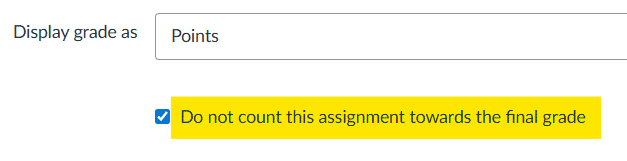
Canvas will then exclude the assignment from the final grade calculation.
2. Missing assignments = 0
If a student was expected to submit an assignment but did not do so, and should receive a grade of 0, that 0 must be entered in the gradebook.
The simplest way is to type 0 directly into the student’s grade cell.
If many students are missing the same assignment, it may be quicker to use Set Default Grade.
Steps
- Open Grades.
- Hover over the assignment column header and click the Options menu.
- Select Set Default Grade.

- Enter 0.

- Click Set Default Grade.
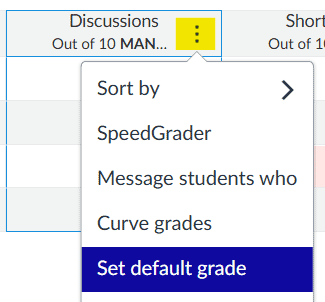
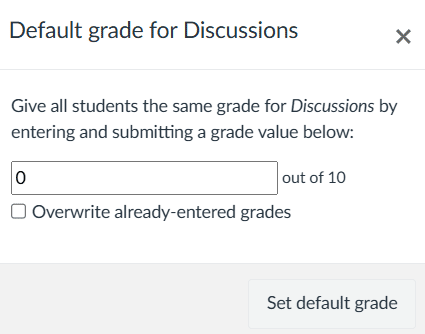
This applies 0 to students who do not yet have a grade for that assignment.
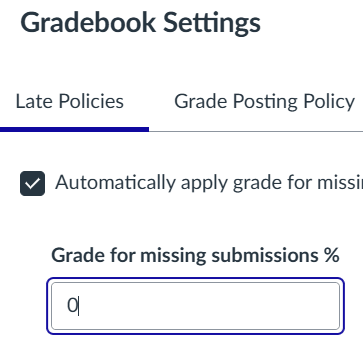
You can also use the gradebook’s missing submission policy so that missing work automatically receives 0. This should be set up at the beginning of the course, before submissions begin.
Steps
- In Grades, click the gear icon in the upper right corner.
- Open the Late Policies tab.
- Set the Missing Submission Policy to 0.

- Save the settings.
3. Excused assignments
If submission of an assignment was optional and a student did not submit it, the assignment should be marked as Excused in the gradebook. An excused assignment is excluded from the student’s total grade, so the weight of the student’s other graded work is adjusted accordingly.
Steps
- Open Grades in the course navigation.
- Find the student and the assignment in the gradebook.
- Click the grade cell for that assignment.
- Click the small arrow that appears in the grade cell.

- In the grade detail panel, select Excused.

After that, the assignment no longer counts toward that student’s final grade.
See also: How do I use the icons and colors in the Gradebook?
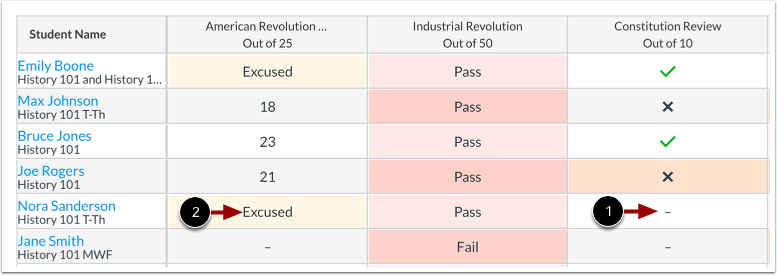
A grade cell showing 0 means the student received zero points for the assignment. A cell with a dash means no grade has been entered for that student for that assignment [1]. If the assignment should not count toward the student’s course total, it can be marked as Excused instead [2].
4. Post all grades
Final grades cannot be transferred from Canvas to Ugla unless grades for all assignments and quizzes in the gradebook have been posted. If a visibility icon with a crossed-out eye appears for an assignment, some grades in that column are still hidden from students.
Steps
- Open Grades in the course navigation.
- Hover over the assignment name at the top of the column.
- Click the three-dot menu that appears.
- Select Post grades.

- In the panel on the right, choose Everyone.
- Click Post.
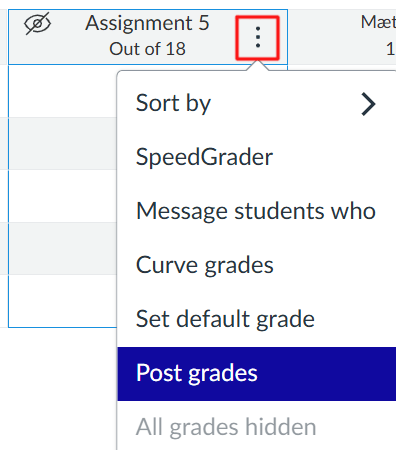
After that, the grades in that assignment column are visible to students. In Canvas, the three-dot menu appears when the pointer is placed over the assignment name at the top of the column.
Final Grade Rounding: Check the Grading Scheme
Þetta er einkunnaskalinn sem liggur til grundvallar við námundun lokaeinkunnar.
