
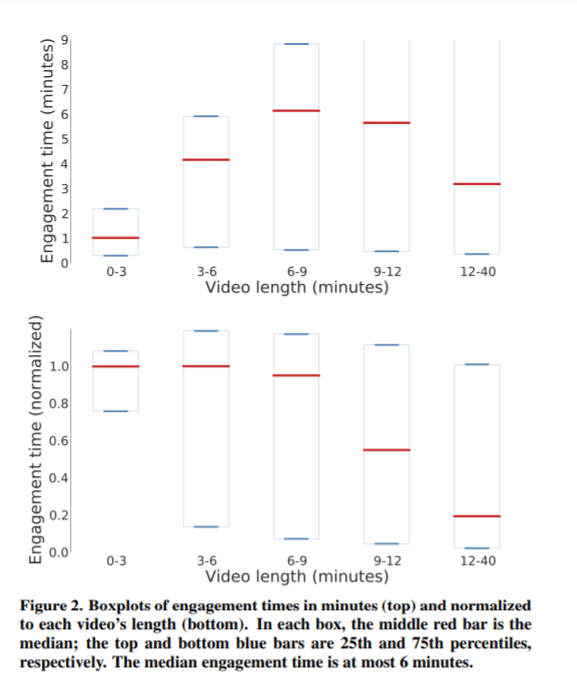
The use of videos in teaching has grown in recent years. Videos are a fundamental part of course content in MOOC (Massive Open Online Course) courses, e.g., at Coursera, edX, and Udacity. One of the most pressing questions is: Which kinds of videos lead to the best student learning outcomes? EdX researched video engagement, using 6.9 million video-watching sessions (watching session = one student watching one video) across four MIT, Harvard, and Berkeley courses.
One of their main findings was that video length was by far the most significant indicator of engagement. Shorter videos are more engaging. Based on their quantitative findings and qualitative insights from interviews with edX staff, they developed a set of recommendations to help instructors and video producers take better advantage of the online video format.
Although perhaps slightly different criteria apply in a regular university environment, these findings and recommendations have an urgent message for those involved in teaching.
| Finding | Recommendation |
|---|---|
| The length of the video was by far the most important indicator of student engagement. Shorter videos significantly increase engagement. | Invest heavily in pre-production lesson planning to segment videos into chunks shorter than 6 minutes. The percentage of viewing time decreases when videos exceed 6 min. |
| Videos that intersperse an instructor’s talking head with slides are more engaging than slides alone. | Invest in post-production editing to display the instructor’s head at opportune times in the video. |
| Videos produced with a more personal feel could be more engaging than high-fidelity studio recordings. | Try filming in an informal setting; investing in big-budget studio productions might not be necessary. |
| Khan-style tablet drawing tutorials are more engaging than PowerPoint slides or code screencasts. | Introduce motion and continuous visual flow into tutorials, along with extemporaneous speaking. |
Even high-quality prerecorded classroom lectures are not as engaging when chopped up for a MOOC. | If instructors insist on recording classroom lectures, they should still plan with the MOOC format in mind. |
| Videos, where instructors speak relatively fast and highly enthusiastically, are more engaging. | Coach instructors to bring out their enthusiasm and reassure them that they do not need to slow down purposely. |
Students engage differently with lecture and tutorial videos. | For lectures, focus more on the first-watch experience; for tutorials, add support for rewatching and skimming. |
In general, when a new communication medium emerges, there is always a tendency to use it in a similar way to existing media. In the early days of television, radio programs were recorded and shown on television, the first digital textbooks were scanned from paper books, and the first online educational videos were recordings of traditional classroom lectures. Eventually, people develop creative ways to take full advantage of the new medium.
Source:
How Video Production Affects Student Engagement: An Empirical Study of MOOC Videos (PDF).